
How Should I Structure My Plate for Autoimmune Healing?
Before you touch an elimination diet, a supplement stack, or any advanced protocol to manage your autoimmune disease, you must work on balancing your plate. Skipping this foundation is one of the most common reasons expensive supplements and complicated protocols don't work.
Here's something that's been pissing me off in the world of autoimmune healing. It's become so. freakin. complicated.
I've recently onboarded a few new autoimmune clients, and there's something I've noticed across every single one of these people.
The protocols they came to me already having done were needlessly complicated.
We're talking thousands of dollars each month on supplements. Even more on tests to identify niche things like every single bacterium found in their colon. Daily routines that make an army boot camp look like summer camp. I mean, no wonder none of these people were healing!
It's not that they weren't putting in the work, arguably, they were all doing more for their health than I do for mine at any given moment. But they weren't doing any of the foundations. They were doing all of these higher level items, many of which have incredible validity, but they had never mastered the foundational items that make these higher level treatments stick.
It's like trying to build a second level of your home without first building the ground floor. You could have the best tools on the planet, world class contractors, the fanciest materials, but without that foundation, it will come crashing down every single time.
That's why structuring your plate correctly cannot be overlooked in autoimmune healing. If you're tempted to click out of this article right now because you're already eating "healthy," give me one second to convince you otherwise. I was in your shoes. I thought I was eating healthy as I embarked on my autoimmune healing journey about a decade ago. I mean, I barely ate "junk," and everyone around me told me I was healthy. But there's a difference between eating nutritious foods and eating in a nutritionally balanced way. And my guess is that you're doing the former.
Simply put: the absence of junk does not mean you're eating the right kinds of foods, balance of foods, or enough food for your healing. And before you dive into elimination diets or intense protocols, you need to master balancing your plate. I know with 100% certainty if I were in your shoes now, I wouldn't bother reading further, but please make sure you're doing the below if you want to heal. Otherwise everything else you do will really be spinning your wheels to get nowhere.
What Are the Root Causes of Autoimmune Disease?
Nutrient deficiencies, nervous system dysregulation, and gut health are the three root causes driving most autoimmune issues, and none of the higher-level protocols work until these three are addressed first. They almost seem too simple to be true, I know.
And you might be thinking, but Jamie, what about mold or environmental toxins? What about heavy metals? Or food sensitivities?
Yes, these can all contribute to your autoimmunity. BUT, you cannot effectively address any of these higher level issues without first ensuring you have adequate nutrient stores, a (somewhat) regulated nervous system, and a healthy gut.
In the most basic of examples, you can't detox from heavy metal exposure if you don't have the nutrients that support phase 1 and 2 detox. You can't run an effective elimination diet and successfully reintroduce foods if you never heal a leaky, inflamed, or dysbiotic gut.
Are you picking up what I'm putting down about autoimmune healing being needlessly complicated? The higher levels are important. But they're not where you spend your energy first when your energy is already so limited. Got it?
And once my clients apply this framework, their energy begins to improve in just a few weeks. It really can be that simple.
So here's how you apply this information...
How Do I Structure My Plate for Autoimmune Healing?
If you want to feel fueled in your autoimmune journey, there's one phrase I want you to remember:
F-F-Fuel Please.
What does this stand for?
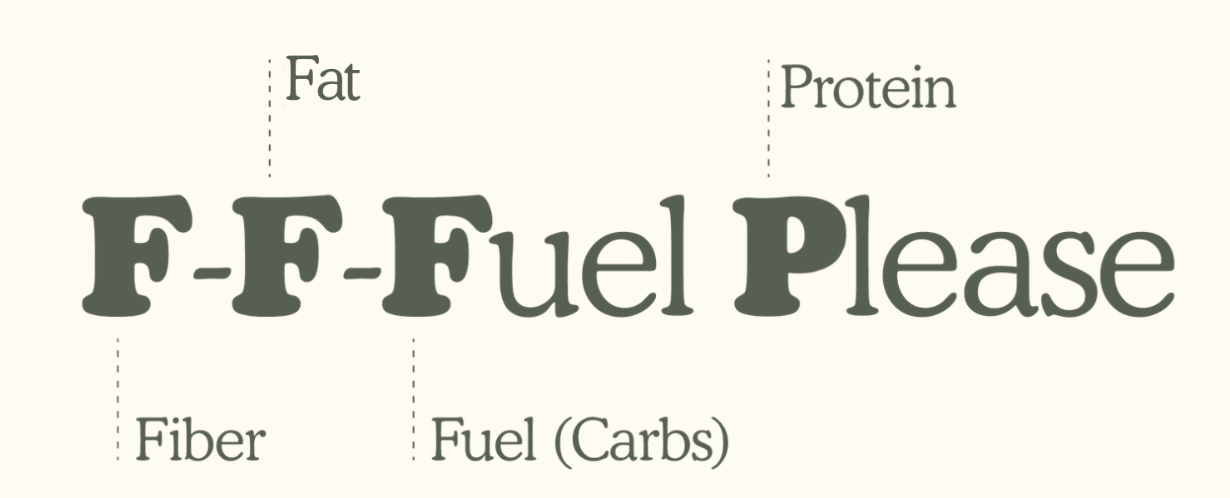
Fiber. Fat. Fuel. And Protein.
Those are the components to your balanced plate. Quickly, I'll break down what they are, what they mean, and how they fuel your healing.
Fuel (yes, we're intentionally going out of order)
This is arguably one of the most important parts of your autoimmune Power Plate and one of the most misunderstood. Your fuel is your carbs. Ideally whole food carbs (ex: fruit, legumes, and starchy veggies) rather than highly processed carbs like white bread, pasta, pastries, or sugar).
Why is Fuel so important? Glucose (what carbs turn into in your bloodstream) is your body's preferred fuel source. No, you do not need carbs to survive. Your body can convert other macronutrients into glucose. But, think about it this way: you don't need shoes to walk down the street. But it's sure as heck easier to walk down the street with a pair of them on.
When your body is already working so hard to heal, why would you do something that makes surviving harder, like making it create its own fuel?
Glucose also reduces the production of cortisol, your stress hormone. And reducing the stress burden on your body is one of the top things to do for autoimmune healing.
So yes, your Fuel supports your nervous system. And, these whole food carbs like fruits and starchy veggies are loaded with the micronutrients your body needs to function.
Carbs are your goldilocks nutrient for sure: too little and your body is too stressed, too much and you can also stress out your body with chronic blood sugar spikes. Aim for about 1 cup per meal to hit this sweet spot.
Fiber
Fiber has some pretty significant overlap with the Fuel category so you might be killing two birds with one stone here. Fiber is found in all plant foods (read: fruit, veggies, legumes, and nuts/seeds). So your fuel will likely have some fiber in it, but you can, and should, add fiber from non-starchy veggies and seeds.
Fiber is important because it is the only fuel source for the bacteria in your gut. Scary but interesting fact: we are made up of more bacterial cells than human cells 🤯. I know. When I first learned that, I felt like I had bugs crawling all over me. But if we are made up of more bacterial cells than human, we must make sure we're feeding them. After all, they not only protect our gut, but generate vitamins, minerals, anti-inflammatory compounds, and even neurotransmitters for us. So, eating fiber supports not just your gut health, but your nutrient status and nervous system health.
Aim for at least one fiber rich food per meal and, ideally, have non-starchy veggies in at least two of your meals.
Fat
Fat is your satiety macronutrient. Not only that, but fats are the building blocks of your cell membranes and your hormones. So getting your healthy fats helps with your gut health and your nutrient needs, especially since some vitamins can't be absorbed without fat (ones like vitamin A or E). The trick here is that people either wildly underdo or overdo fats. Stick to 1-2 servings per meal (typically 100-200 additional calories from fat per meal).
Protein
In my mind, I picture protein as the bouncer to an exclusive club, the club being your small intestine. Quite the party, right? Now your Fuel (carbs) are like eager 21 year olds: vital to the club staying in business, but they'll rush in all at once if you don't have a bouncer. In short, you need the protein to slow down how quickly the carbs enter your small intestine and thus your bloodstream so you don't have a massive blood sugar spike.
On top of this, many protein rich foods contain plenty of vitamins and minerals you need, such as the B vitamin family, making them nutrient rich.
Aim for a minimum 25g per meal, not including the small amounts of protein coming from nuts, seeds, and legumes.
Putting It All Together
As you go to make your meals, run it through the F-F-Fuel Please framework to make sure they fit. The more consistently you add F-F-Fuel Please plates to your day, the more you support your body to heal.
I’ve seen clients significantly improve bloating, fatigue, joint pain, and chronic inflammatory pain within weeks just by balancing their plates.
You don't need a $500 supplement stack or a restrictive elimination diet to start healing from autoimmune disease. You need a plate that's actually built to support you, and that's where every protocol should start.
Mastering this foundation is the first step. If you're ready for a personalized plan built around your labs, your history, and your body (not a generic protocol), you can find more info on working with me here.
FAQ
What is the best diet for autoimmune disease?
There's no single best diet for autoimmune disease, it depends on which condition you have, how long you've had it, and what you have the capacity to try. But before any elimination diet or protocol, your plate needs a foundation of balanced fiber, fat, fuel (carbs), and protein at every meal. If symptoms linger beyond that (and other targeted healing treatments) then an elimination diet may be warranted.
Can autoimmune disease be reversed with diet?
Diet alone is rarely enough, but a properly structured plate is the foundation every other intervention builds on. While it is possible to reverse some autoimmune conditions, that depends on which condition you have and how long you've had it for.
What are the root causes of autoimmune disease?
Nutrient deficiencies, nervous system dysregulation, and gut health are the three root causes driving most autoimmune issues. Higher-level factors like mold, heavy metals, or food sensitivities can contribute, but they can't be effectively addressed until these three foundations are in place.
Do I need to do an elimination diet to heal autoimmune disease?
Not right away. Structuring your plate with balanced fiber, fat, fuel, and protein needs to come before any elimination diet or intense protocol, otherwise you risk spinning your wheels without addressing the foundations that make those higher-level treatments actually work.
